
What to Consider When Planning Coffee Catering for a Fall Corporate Event
/
Fall corporate events have a different rhythm than summer gatherings. The weather can change quickly, mornings can feel noticeably cooler, and an event that starts outdoors may move inside as the day progresses.
That makes coffee catering for a fall corporate event more than a matter of choosing a few seasonal flavors.
The most important considerations are event timing, weather, hot and iced beverage options, guest traffic, service capacity, venue logistics, menu design, and the role coffee should play in the overall guest experience.
For corporate planners in Southern California, these details can make the difference between a coffee station that simply provides caffeine and a beverage experience that feels intentionally designed for the event.
Here is what to consider before booking coffee catering for your next fall corporate gathering.
How should fall weather affect coffee catering for a corporate event?
Fall weather should influence where the coffee bar is placed, which beverages are offered, and how guests will move through the event. In Southern California, fall can mean cool mornings, comfortable afternoons, and significant temperature changes depending on the venue and time of day.
This is especially important for events that take place outdoors.
A morning corporate event in September or October may begin with guests wanting something hot and comforting, while the same event can feel considerably warmer by early afternoon. Rather than designing the beverage menu around one temperature, it is usually better to give guests meaningful choices.
For an outdoor event, planners should also think about the physical placement of the coffee bar.
The setup should be positioned in a practical location that works with the event's traffic pattern while providing reasonable protection from direct sun. Depending on the venue, that may mean using an existing shaded area, providing umbrellas, or arranging a canopy for the coffee service.
The goal is not to over-engineer the weather plan. It is simply to make sure the coffee bar remains comfortable, accessible, and functional throughout the event.
Should a fall corporate event offer both hot and iced coffee?
Usually, yes. Offering both hot and iced coffee gives guests flexibility as temperatures change throughout the day.
A fall menu does not need to force every guest into a pumpkin-spice version of a hot latte.
A better approach is to maintain a strong core menu while adding a few seasonal options.
For example, guests might choose from:
Espresso
Americano
Latte
Cappuccino
Iced latte
Seasonal flavored latte
Decaffeinated coffee
Dairy and non-dairy milk options
This creates a menu that feels appropriate for fall without becoming so seasonal that it limits guest choice.
For corporate events, flexibility is particularly valuable because attendees rarely arrive with identical preferences. One guest may want a hot cappuccino before a morning meeting, while another may prefer an iced latte before heading into an afternoon session.
A well-planned corporate coffee bar should accommodate both.
What fall coffee flavors work best for corporate events?
The best fall coffee menu uses seasonal flavors as accents rather than making the entire beverage program seasonal.
Fall gives planners plenty of opportunities to introduce warmer flavor profiles without turning the coffee bar into a themed novelty station.
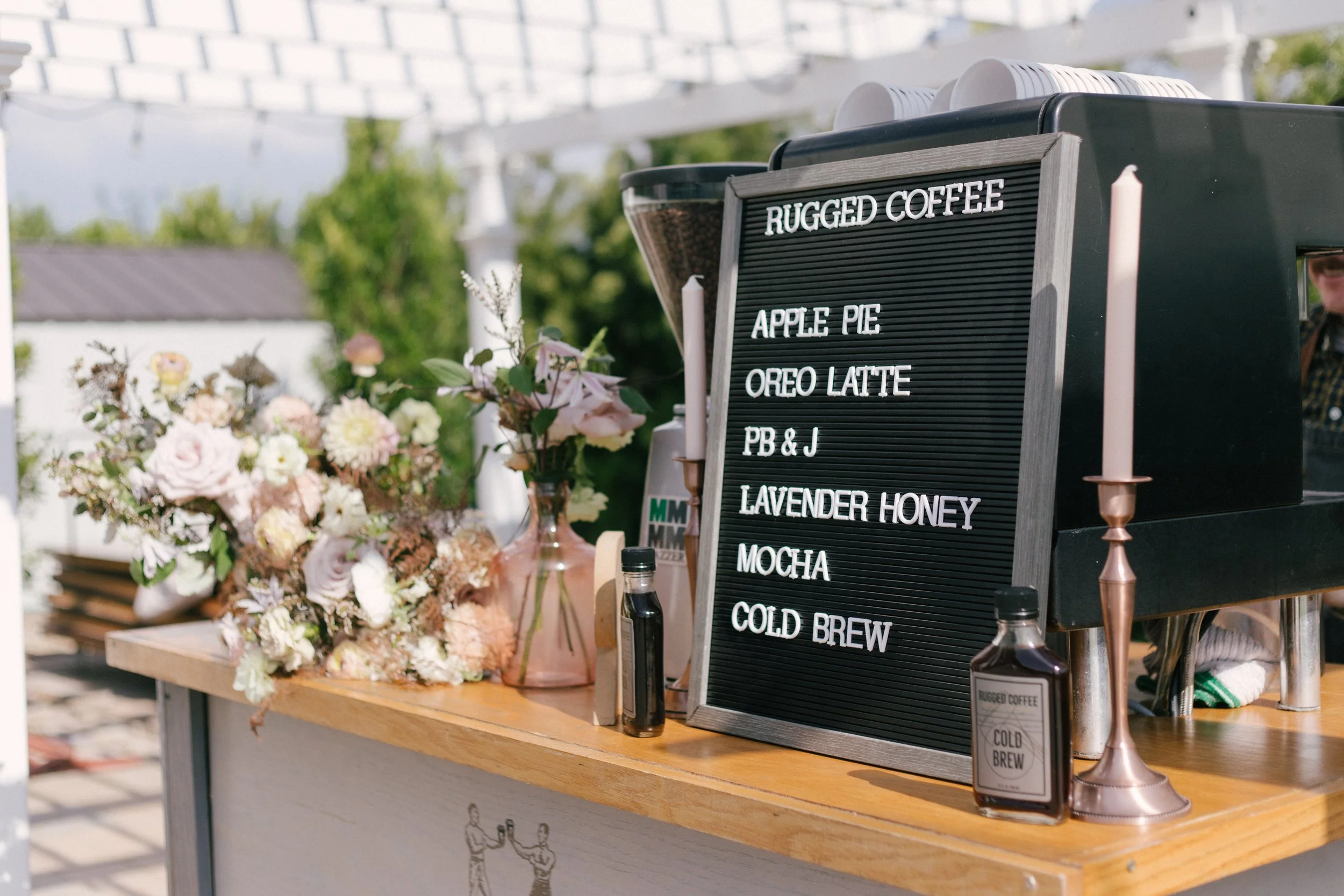
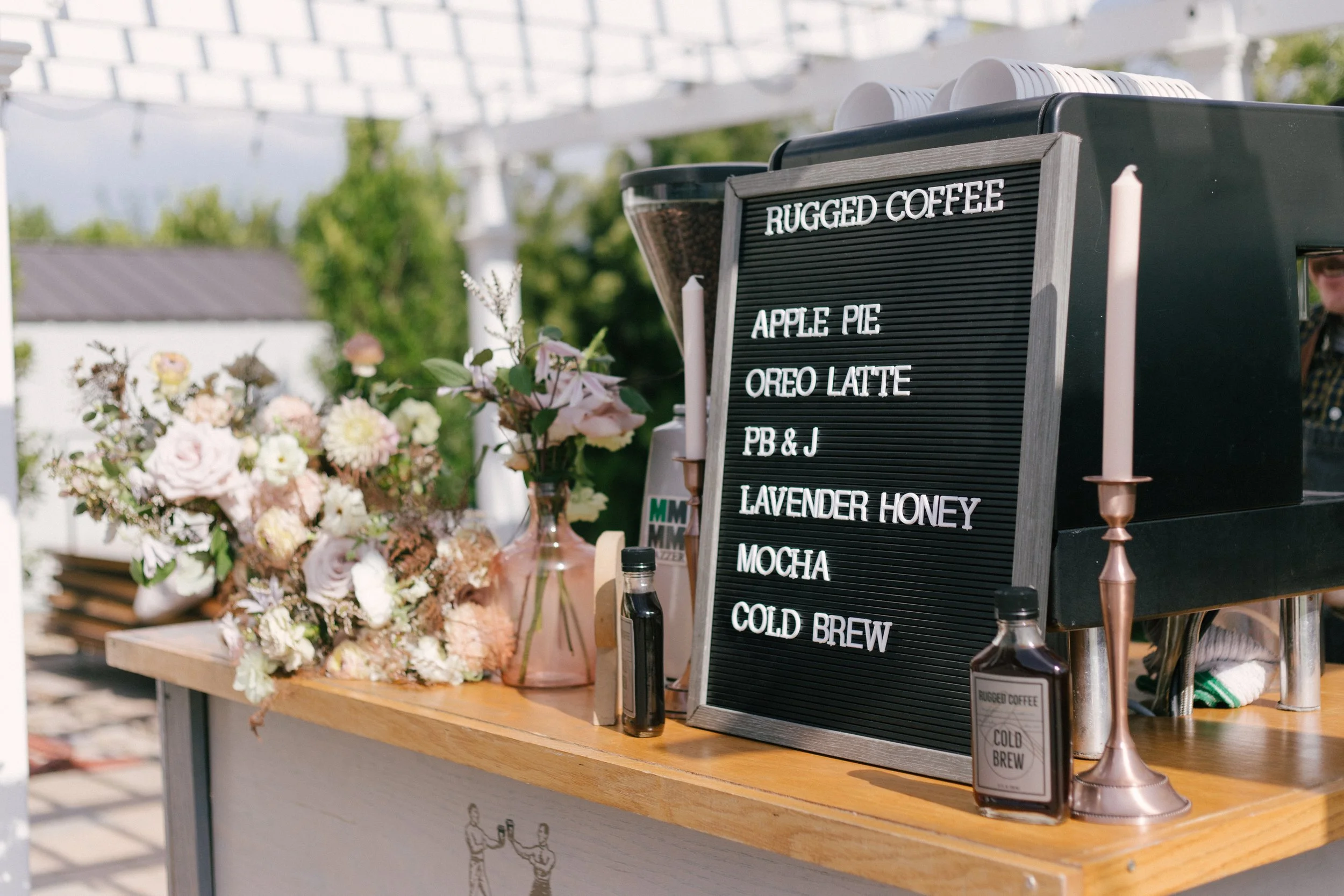
Good seasonal directions can include:
Churro Latte
Apple Pie Latte
PB & J Latte
Maple Spice
Pumpkin Spice (Pie) Latte
Chestnut Praline Latte
The key is restraint.
A corporate event usually benefits from a menu that feels polished and approachable rather than one built around a dozen competing seasonal flavors.
One or two signature fall beverages can create the seasonal connection without overwhelming the core espresso menu.
For example, a corporate event could offer its standard latte alongside a cinnamon-maple latte or a seasonal brown sugar espresso drink.
That approach gives planners something distinctive to promote while still allowing guests to order familiar beverages.
It also makes the menu easier for baristas to execute consistently during busy periods.
How should you plan coffee service around the event schedule?
Coffee service should be planned around when guests are most likely to want coffee, not simply around the total length of the event.
This is one of the most important considerations for corporate coffee catering.
A three-hour event does not necessarily create three hours of equal beverage demand.
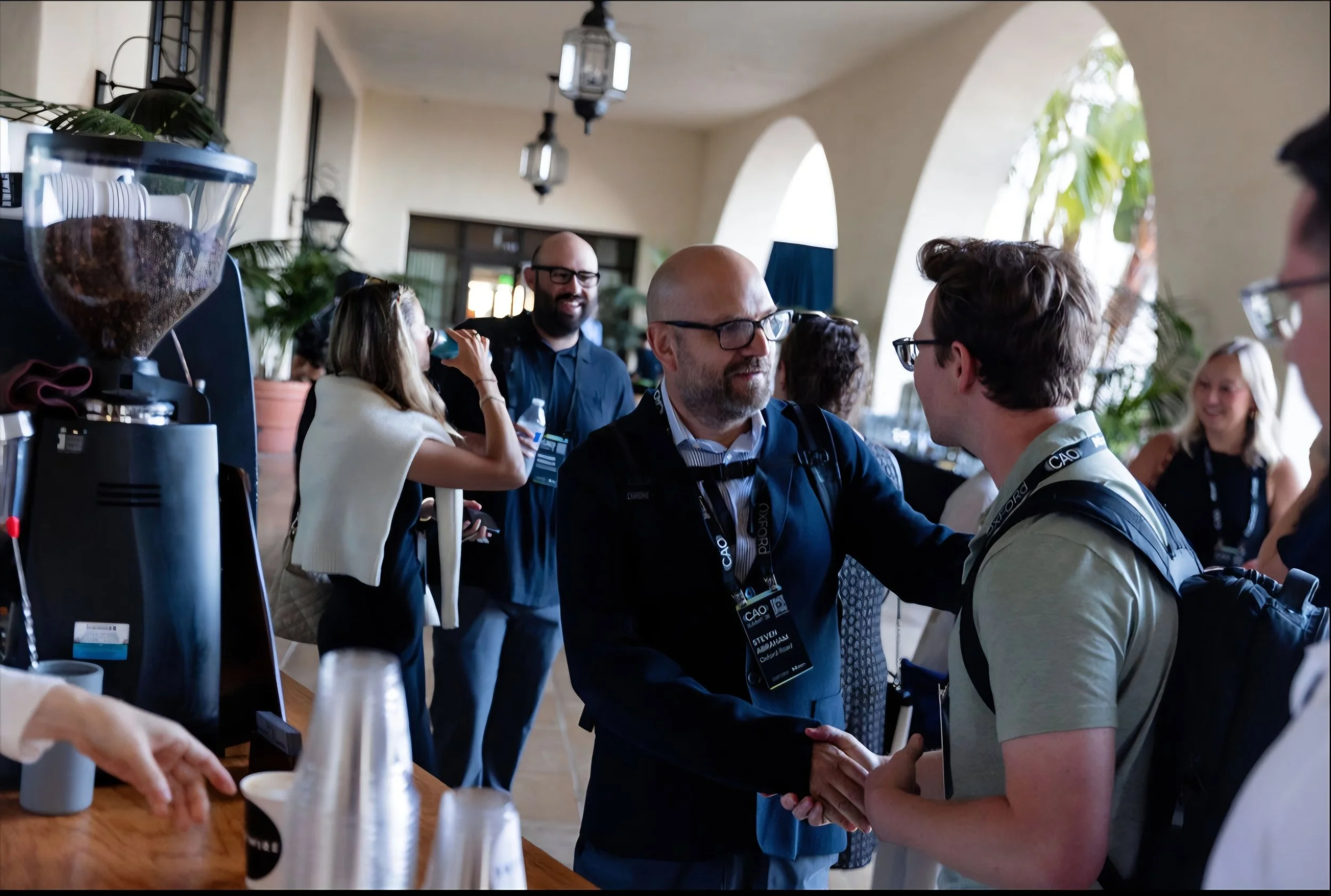
A typical corporate event might have a significant rush immediately after guests arrive, another spike during a scheduled break, and a smaller stream of orders during presentations or networking.
That means planners should consider:
Guest arrival time
Registration periods
Breakfast or morning networking
Scheduled breaks
Session transitions
Lunch
Afternoon networking
Event conclusion
If 150 attendees all arrive within a short registration window, the coffee bar needs to be prepared for that concentrated demand.
If guests arrive gradually over several hours, the service pattern may be completely different.
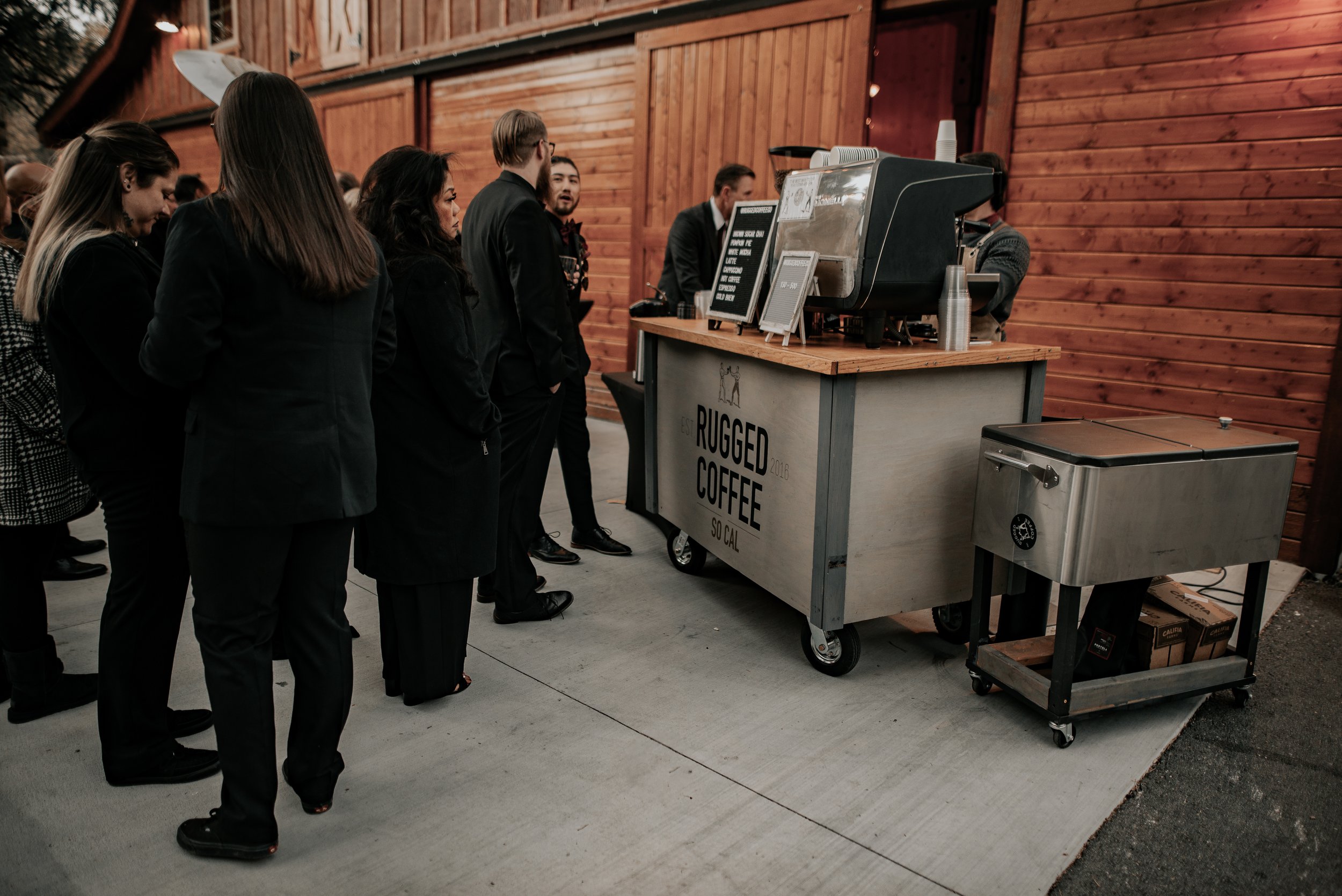
At Rugged Coffee, this is one of the practical differences between catering an event and simply setting up a coffee station. The beverage service has to work within the event's actual timeline.
The coffee bar is part of the event operation.
That means considering where guests will be, when they will be there, and what will happen when a large group arrives at once.
For larger corporate events and conferences, service capacity becomes even more important. Rugged Coffee's existing high-volume coffee catering guide goes deeper into the operational considerations involved when beverage demand increases.
Does the time of day matter when planning fall corporate coffee catering?
Yes. The event's start time and schedule should influence the menu, service flow, and overall coffee experience.
A 7:30 a.m. leadership meeting has very different beverage expectations than a 3:00 p.m. employee appreciation event.
For early-morning events, coffee may function primarily as hospitality and fuel. Guests are arriving, networking, and preparing for the day.
For an afternoon event, coffee may play a different role. It can become a social beverage, a networking touchpoint, or a complement to dessert.
This distinction can influence everything from menu design to service duration.
Morning corporate events
Consider emphasizing:
Espresso beverages
Brewed coffee
Hot milk-based drinks
Decaffeinated options
Non-dairy milk
Artisan pastries
Afternoon corporate events
Consider emphasizing:
Espresso beverages
Iced coffee drinks
Seasonal specialty beverages
Dessert pairings
Affogatos
Coffee infused cocktails when appropriate for the event
The beverage program should support what guests are actually doing rather than exist independently from the event schedule.
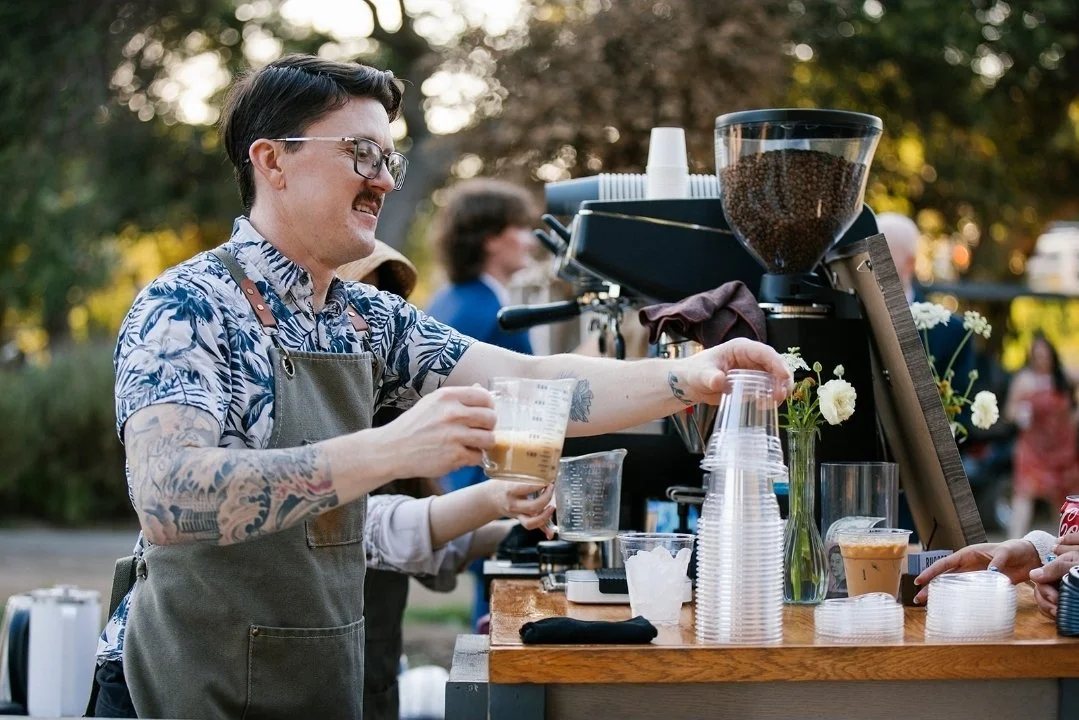
Is an indoor or outdoor venue better for fall coffee catering?
Neither is inherently better. The important question is whether the coffee setup is planned around the venue's environment and guest flow.
Fall corporate events are often attractive because they can take advantage of Southern California's outdoor spaces without the intensity of summer heat.
That can create excellent opportunities for a mobile espresso bar.
But outdoor service requires more planning.
Consider:
Shade
Guest traffic
Weather changes
Surface conditions
Access for load-in
Proximity to electrical power
Placement relative to the event's main activity
For an indoor event, the considerations change.
The coffee bar may need to fit within a ballroom, conference room, lobby, hallway, reception space, or networking area. Its location should be convenient without creating congestion.
The best placement is rarely determined by aesthetics alone.
A beautiful coffee bar in the wrong location can create a bottleneck. A less prominent location positioned directly along a natural guest pathway may perform much better.
For more on how outdoor beverage planning changes the service model, see Rugged Coffee's guide to coffee drinks for outdoor corporate events in California.
What venue logistics should you confirm before booking a coffee caterer?
Confirm power, setup location, access, load-in requirements, venue restrictions, and available service space before the event date.
This is one of the easiest areas to overlook when planning corporate coffee catering.
A planner may know exactly where the coffee bar should go from a design perspective, only to discover that the location does not have appropriate electrical access.
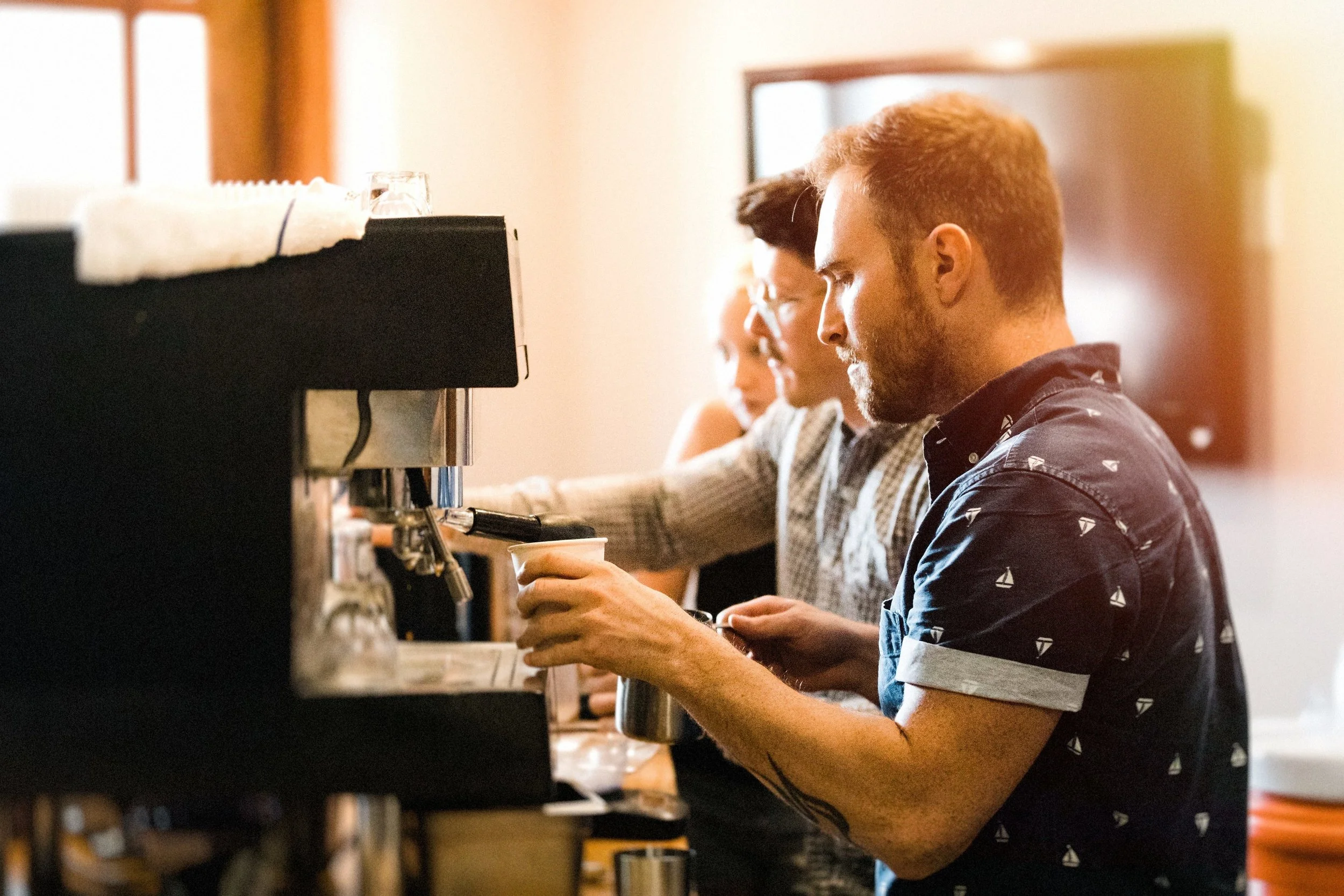
For a professional espresso setup, power is not a minor detail.
Rugged Coffee's standard espresso equipment requires dedicated electrical access, and the exact requirements should be confirmed with the venue during planning.
Other logistics can include:
Where the catering team can load in
When vendors are allowed to arrive
Whether elevators or loading docks are required
How far equipment must be transported
Where the coffee bar can be positioned
Whether the venue has restrictions on outside catering
Available electrical outlets
Guest traffic patterns
Cleanup and breakdown requirements
These details are much easier to solve before the event than on event day.
A professional coffee caterer should be asking these questions during the planning process rather than waiting for the planner to discover them.
How much coffee service capacity does a corporate event need?
Service capacity should be based on guest count, peak demand, event timing, menu complexity, equipment, staffing, and the number of beverage stations.
Guest count alone does not tell the entire story.
Two corporate events with 200 attendees can have dramatically different beverage requirements.
One might have guests arriving over two hours.
Another might release 200 people from a conference session at the same time.
The second event creates a much more concentrated rush.
Menu design also affects service.
A simple menu with a few streamlined beverages can move differently from a large menu with numerous customizations.
This is why professional event coffee catering requires more than bringing an espresso machine to a venue.
Equipment, barista staffing, workflow, bar layout, and guest flow all have to work together.
If your event involves hundreds or thousands of attendees, the planning conversation should shift toward high-volume event operations rather than treating the coffee bar like a small private gathering.
Should coffee be treated as a refreshment or part of the corporate hospitality experience?
The answer depends on what you want the coffee service to accomplish at the event.
This is an important planning question because coffee can serve several different purposes.
It can simply be a refreshment.
It can support networking.
It can welcome guests.
It can provide hospitality for clients or executives.
It can complement a brand activation.
Or it can become one of the memorable experiences guests associate with the event.
Those are different objectives.
If coffee is simply there to keep attendees caffeinated, the planning priority may be convenience and availability.
If coffee is part of the guest experience, then presentation, service, menu design, barista interaction, and placement become much more important.
This is also where a mobile espresso bar can differ significantly from traditional venue coffee service. Rugged Coffee's comparison of coffee catering and traditional venue coffee service explores that distinction in greater detail.
The important thing is to decide what job the coffee is supposed to perform before choosing the service model.
What should be included in a fall corporate coffee menu?
A strong fall corporate coffee menu should balance familiar espresso beverages, seasonal choices, dietary flexibility, and the event's schedule.
There is no need to create a giant menu.
A focused menu is often easier for guests to understand and easier for the barista team to execute consistently.
A practical corporate fall menu might include:
Core espresso beverages
Latte
Cappuccino
Americano
Espresso
Macchiato
Seasonal choices
Churro Latte
Maple Spice latte
Pumpkin Pie latte
Apple Pie latte
PB & J latte
Iced options
Iced latte
Iced Americano
Seasonal iced specialty drink
Milk options
Whole milk
Oat milk
Other available non-dairy options
The exact menu should depend on the event rather than following a generic seasonal template.
A financial conference, employee appreciation event, executive retreat, and trade show may all take place in the fall, but they do not necessarily need the same coffee program.
How can a corporate coffee bar accommodate guests with different preferences?
Build flexibility into the menu without making the menu unnecessarily complicated.
Corporate events bring together people with different tastes, dietary preferences, caffeine preferences, and expectations.
That means planners should consider more than the signature seasonal drink.
Useful options may include:
Dairy-free milk
Decaffeinated coffee
Hot beverages
Iced beverages
Espresso-forward drinks
Milk-based drinks
Less-sweet options
The objective is not to accommodate every imaginable beverage request.
It is to make sure the core menu gives a broad range of guests something they will actually want.
That is one reason a carefully designed espresso bar can work well at corporate events. Guests can interact with the barista and choose a beverage based on their own preferences rather than taking whatever happens to be sitting in a dispenser.
Should you add branding to a corporate coffee bar?
Branding is worth considering when the coffee bar is part of the event's visual experience, client hospitality, or brand activation.
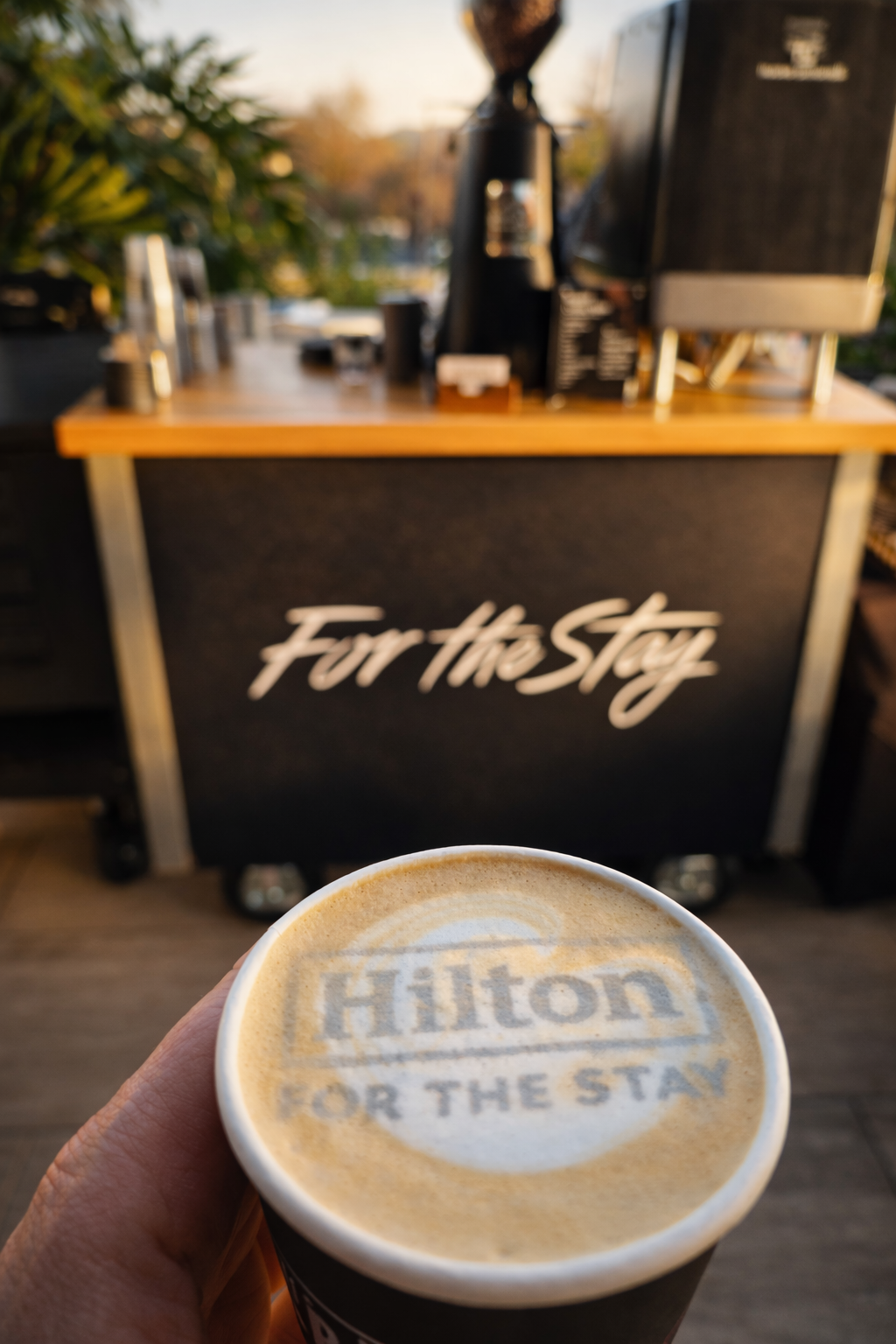
Corporate coffee catering can be branded in subtle ways without turning the beverage station into an advertisement.
Depending on the event, options can include:
Custom menu displays
Branded signage
Event-specific beverage names
Custom cups or sleeves
Signature drinks
A coffee menu inspired by the company's branding
The key is relevance.
A corporate coffee bar should still look like a thoughtful hospitality experience.
Branding should enhance the environment rather than overpower it.
For a conference or trade show, the coffee bar may also be positioned strategically within a branded area. For an executive gathering, the approach may be considerably more understated.
The right treatment depends on the role coffee plays within the event.
Where should the coffee bar be placed at a corporate event?
Place the coffee bar where guests naturally move, while avoiding bottlenecks and making sure the service team has enough room to operate.
Coffee bar placement is an operational decision disguised as a design decision.
Placing the bar too far from the main guest area can make it easy to overlook.
Placing it directly in a narrow hallway can create congestion.
A better location might be:
Near registration
Along a networking route
Outside a meeting room
Near a lounge
Within an exhibitor or activation area
Adjacent to a breakfast or reception space
Think about the journey guests are already taking through the event.
Where do they naturally pause?
Where do they gather?
Where do they transition between sessions?
Where can they comfortably wait for a beverage without blocking other guests?
Those questions often reveal a better coffee-bar location than simply choosing the most visually prominent corner of the venue.
When should you book coffee catering for a fall corporate event?
Book as early as practical, particularly if your event falls during a busy corporate event season or requires a specific date, venue, staffing plan, or custom experience.
Fall can be a busy period for corporate events, conferences, company celebrations, and private gatherings.
Waiting until the last minute can limit your options for:
Preferred event dates
Staffing
Custom menu development
Branding
Venue coordination
Additional service requirements
The earlier planning begins, the more time there is to resolve logistical questions.
This is especially important for events with unusual venue restrictions, outdoor components, large guest counts, or multiple beverage stations.
The goal is not simply to reserve a date.
It is to give the catering team enough information to design the right service around the event.
What should you ask a coffee caterer before booking?
Ask how the caterer plans for guest count, peak demand, venue logistics, staffing, equipment, menu design, and the overall event experience.
A useful conversation should go beyond, "How much does your coffee cart cost?"
Consider asking:
How do you determine staffing for our guest count?
How do you handle peak periods?
What are your power requirements?
What does your setup require from the venue?
Can the menu include both hot and iced beverages?
Can seasonal drinks be customized?
What milk options are available?
How does your service work at outdoor events?
How far in advance should we reserve?
What is included in the catering experience?
Do you handle setup and breakdown?
Can the coffee experience be incorporated into our event branding?
The answers can tell you a great deal about whether a vendor understands corporate event operations or simply provides a coffee cart.
For a broader framework on evaluating vendors, see How to Choose the Best Coffee Caterer for Your Corporate Event in Southern California.
What makes fall corporate coffee catering different in Southern California?
Southern California fall events require flexibility because the season does not always behave like a traditional fall climate.
A corporate event in San Diego, Orange County, Los Angeles, the Inland Empire, Palm Springs, or another Southern California market can have very different weather and venue conditions.
A September event may still feel distinctly summer-like.
A November morning can feel cool enough for guests to appreciate a hot latte.
An outdoor event in one location may have completely different conditions from an indoor conference in another.
That makes rigid seasonal planning less useful than adaptable planning.
The strongest fall coffee programs account for the actual event environment rather than relying on a generic "fall menu."
This is one of the reasons event-specific planning matters so much.
Rugged Coffee has been serving events since 2016, and the practical lesson is straightforward: the beverage plan should follow the event rather than forcing the event to fit the beverage plan.
A simple fall corporate coffee catering planning framework
Before booking, work through these six questions:
1. When will guests actually want coffee?
Look at arrival, breaks, networking periods, meals, and event transitions.
2. What will the weather likely feel like?
Decide whether guests will primarily want hot beverages, iced beverages, or a combination.
3. What should the seasonal menu accomplish?
Choose one or two fall flavors that complement the event instead of overwhelming the menu.
4. Where will the coffee bar operate?
Confirm indoor or outdoor placement, guest flow, shade, space, access, and power.
5. How concentrated will beverage demand be?
Identify moments when large groups will arrive at the coffee bar simultaneously.
6. What role should coffee play?
Decide whether it is simply refreshment, a hospitality amenity, a networking touchpoint, or part of the overall event experience.
If those six questions have clear answers, the rest of the planning becomes considerably easier.
Fall Corporate Coffee Catering Checklist
Before finalizing your event coffee service, confirm:
Event date and service hours
Estimated guest count
Guest arrival pattern
Major breaks and schedule transitions
Indoor or outdoor location
Expected weather conditions
Coffee bar placement
Guest traffic flow
Available electrical access
Venue restrictions
Hot and iced beverage options
Seasonal flavors
Dairy and non-dairy milk options
Decaffeinated option
Branding requirements
Staffing and service capacity
Load-in and breakdown requirements
Catering reservation timeline
Planning a Fall Corporate Coffee Event With Rugged Coffee
The best fall corporate coffee catering plan is not necessarily the one with the biggest menu or the most elaborate seasonal concept.
It is the one that fits the event.
That means matching the coffee service to the schedule, anticipating changes in temperature, offering enough beverage flexibility, planning around peak guest demand, confirming venue logistics, and deciding how important coffee is to the overall hospitality experience.
For planners looking for a fully staffed mobile espresso experience, Rugged Coffee provides specialty coffee catering throughout Southern California and Las Vegas, with service designed around guest count, event timing, venue requirements, staffing, and event goals.
The company has served events since 2016, including corporate gatherings, conferences, trade shows, and other large-scale events.
If your fall corporate event needs more than a basic beverage station, the next step is to build the coffee service around the event itself.
Explore Rugged Coffee's Luxury Espresso Bar Catering to see how a professional mobile espresso experience can be structured for corporate events, conferences, and other gatherings.
The best fall coffee experience starts long before the first latte is poured. It starts with planning the service around the people, place, and purpose of the event.